STEM CELL DIFFERENTATION AND CANCER
Tissue homeostasis requires a precise balance between stem cell differentiation and terminal differentiation. This balance is disrupted in a host of human diseases, including cancer. In epithelia, stem cell progenitors adjacent to an underlying basement membrane undergo cycles of cell division prior to entering the differentiation pathway. The mechanisms that coordinate this transition in both health and disease are not fully understood.
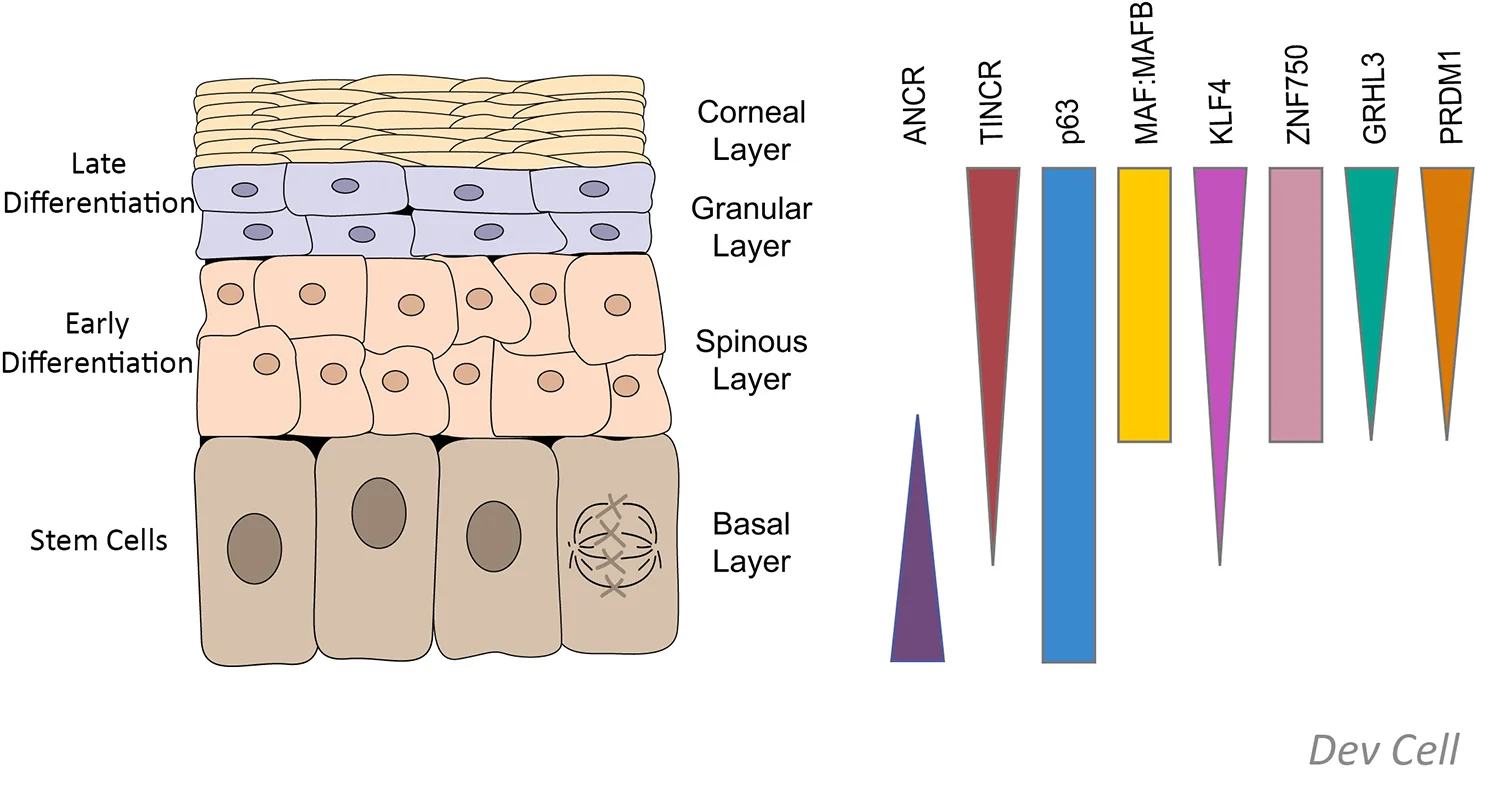
Stem cell differentiation in stratified epithelia, such as cutaneous epidermis, is spatially coordinated. Proliferating progenitors adherent to the basement membrane undergo cell cycle exit followed by outwards migration, then induction of early and late differentiation genes. This process can be replicated in model systems actively studied in the lab, including in calcium-induced differentiation in 2-dimensional cell culture, in 3-dimensional organotypic culture where the entire tissue is faithfully regenerated on native matrix, and in vivo in mice or in human skin-mouse xenografts. Because of its accessibility and medical relevance, the skin represents an ideal model in which to study stem cell differentiation. Using new genetic models noted below, the lab has achieved multi-gene knock-outs in intact epidermis within weeks. These approaches enable unprecedented speed and versatility in stem cell differentiation studies and are helping illuminate the key regulators and networks involved in this process. The lab is using these powerful models to identify and characterize new transcription factors (TFs), lncRNAs, epigenomic regulators, and signaling pathways with essential roles in epidermal stem cell differentiation.
Cancer is a disorder of uncontrolled proliferation associated with a failure of somatic cells to differentiate. In epithelia, where ~90% of human malignancies arise, a non-invasive precancerous phase, characterized by hyper-proliferation and impaired differentiation, precedes progression to invasion through the basement membrane. The skin, as the most common site of cancer in humans, comprises an accessible prototype of epithelial malignancies. By disrupting specific networks found to be mutated in human cancers, the lab created the first human tissue models of invasive cancer and is using these powerful and faithful models to both characterize cancer mechanisms as well as to develop new therapies. These efforts integrate cancer genomics data from lab studies as well as from TCGA and other sources to guide experimentation in these cutting edge human tissue cancer models.